Introduction
In modern infrastructure projects, pipes play a critical role in drainage, sewerage, irrigation, and road construction. Among various pipe systems, Precast Pipes, commonly known as RCC Pipes or Hume Pipes or Precast Concrete Pipes, are the most widely used in India due to their strength, durability, and cost-effectiveness.
This blog explains:
- What precast pipes are
- What RCC / Hume pipes mean
- How they are manufactured
- Where they are used
- Why they are preferred over in-situ construction
1️⃣ What Are Precast Pipes?
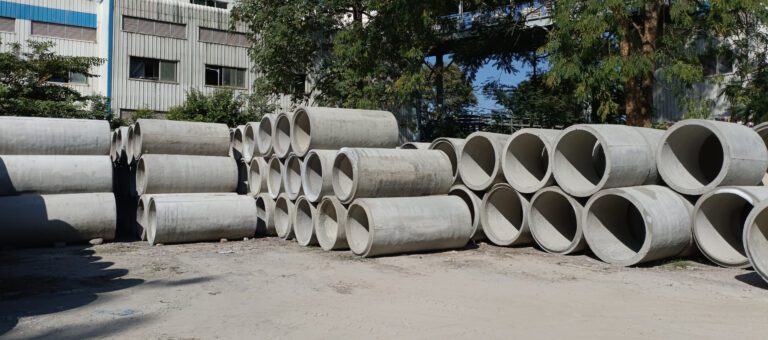
Precast pipes are concrete pipes that are manufactured in a controlled factory environment, cured properly, and then transported to the site for installation.
Unlike in-situ (cast-at-site) pipes, precast pipes offer:
- Consistent quality
- Faster project execution
- Better strength control
- Reduced site labour dependency
Key Characteristics
- Factory-made using steel moulds
- Proper vibration or spinning for compaction
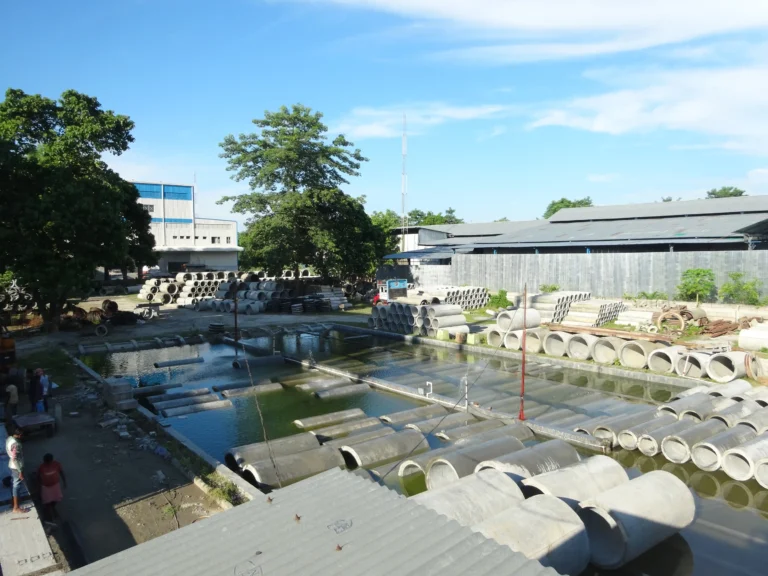
- Water curing or steam curing
- Tested before dispatch


2️⃣ What Are RCC Pipes or Hume Pipes?
RCC Pipes are Reinforced Cement Concrete pipes manufactured with steel reinforcement cages embedded inside concrete to carry structural loads.
They are governed by IS 458:2021 – Precast Concrete Pipes (with and without Reinforcement).
Why Reinforcement Matters
- Handles earth load & traffic load
- Improves crack resistance
- Ensures longer service life
- Suitable for heavy-duty applications
RCC pipes are classified as:
- NP2 – Non-pressure, light duty
- NP3 – Medium duty
- NP4 – Heavy duty
3️⃣ Why Are RCC Pipes Called Hume Pipes?
The term “Hume Pipe” comes from the spun (centrifugal) manufacturing process, originally developed by Walter Hume.
In India:
- Engineers say RCC pipes
- Contractors say Hume pipes
- IS codes say Precast Concrete Pipes
👉 Practically, RCC pipes and Hume pipes refer to the same product when manufactured using the spinning method.
4️⃣ Manufacturing Process of Precast RCC Hume Pipes
Step-by-Step Process
- Reinforcement Cage Fabrication
- Placement of Cage inside Steel Mould
- Concrete Pouring
- Centrifugal Spinning / Vibration
- Initial Setting & Demoulding
- Water / Steam Curing
- Hydraulic Load Testing
- Inspection & Dispatch
This controlled process ensures uniform thickness, higher density, and superior strength.
5️⃣ Joint Types Used in Precast RCC Hume Pipes
Precast pipes can be supplied with different jointing systems as per IS 458:2021:
- Collar Joint – Common for NP2 pipes
- Flush Joint (Tongue & Groove) – Preferred for NP3 & NP4
- Spigot & Socket (S&S) Joint – With or without rubber ring
- Rubber Ring Joint – Leak-proof, flexible joint
👉 Joint selection depends on load class, soil condition, and project requirement.
6️⃣ Applications of Precast RCC / Hume Pipes
Precast RCC pipes are used in:
- Storm water drainage
- Sewerage systems
- Road & highway culverts
- Irrigation pipelines
- Industrial effluent lines
- Railway & airport projects
7️⃣ Why Precast RCC Hume Pipes Are Preferred Over In-Situ Pipes
| Parameter | Precast RCC Pipes | In-Situ Pipes |
|---|---|---|
| Quality | Factory controlled | Site dependent |
| Speed | Very fast | Slow |
| Strength | Tested | Uncertain |
| Labour | Less | High |
| Durability | High | Variable |
8️⃣ Precast RCC Hume Pipes in North-Eastern States
In the North-Eastern region of India, usage patterns are well defined:
- NP2 pipes → Mostly Collar Joints
- NP3 & NP4 pipes → Mostly Flush Joints for highways & urban drainage
At Raj Concrete Products, we manufacture:
- RCC Spun (Hume) Pipes
- NP2 / NP3 / NP4 classes
- Spigot & Socket, Flush Joint, Collar joints available
- Diameter range: 100 mm to 2400 mm
We also supply Precast Box Culverts and Boundary Walls, serving PWDs, contractors, and infrastructure agencies across Assam and the North-East.
9️⃣ Conclusion
Precast pipes, commonly known as RCC or Hume pipes, are a backbone of modern infrastructure. Their factory-controlled quality, structural reliability, and fast installation make them the preferred choice for drainage and sewerage projects.
When manufactured as per IS 458:2021, precast RCC pipes ensure:
- Long service life
- Structural safety
- Economical construction
For reliable supply and consistent quality, choosing an experienced precast manufacturer is key. Contact @ +91-9435710030